Exclusive vs Non-Exclusive Vocals: Which License Do You Actually Need?
Exclusive or non-exclusive? What each license actually transfers, what they cost across marketplaces, and why the stream math favors non-exclusive for most producers.
Kilian27 September 20267 min read
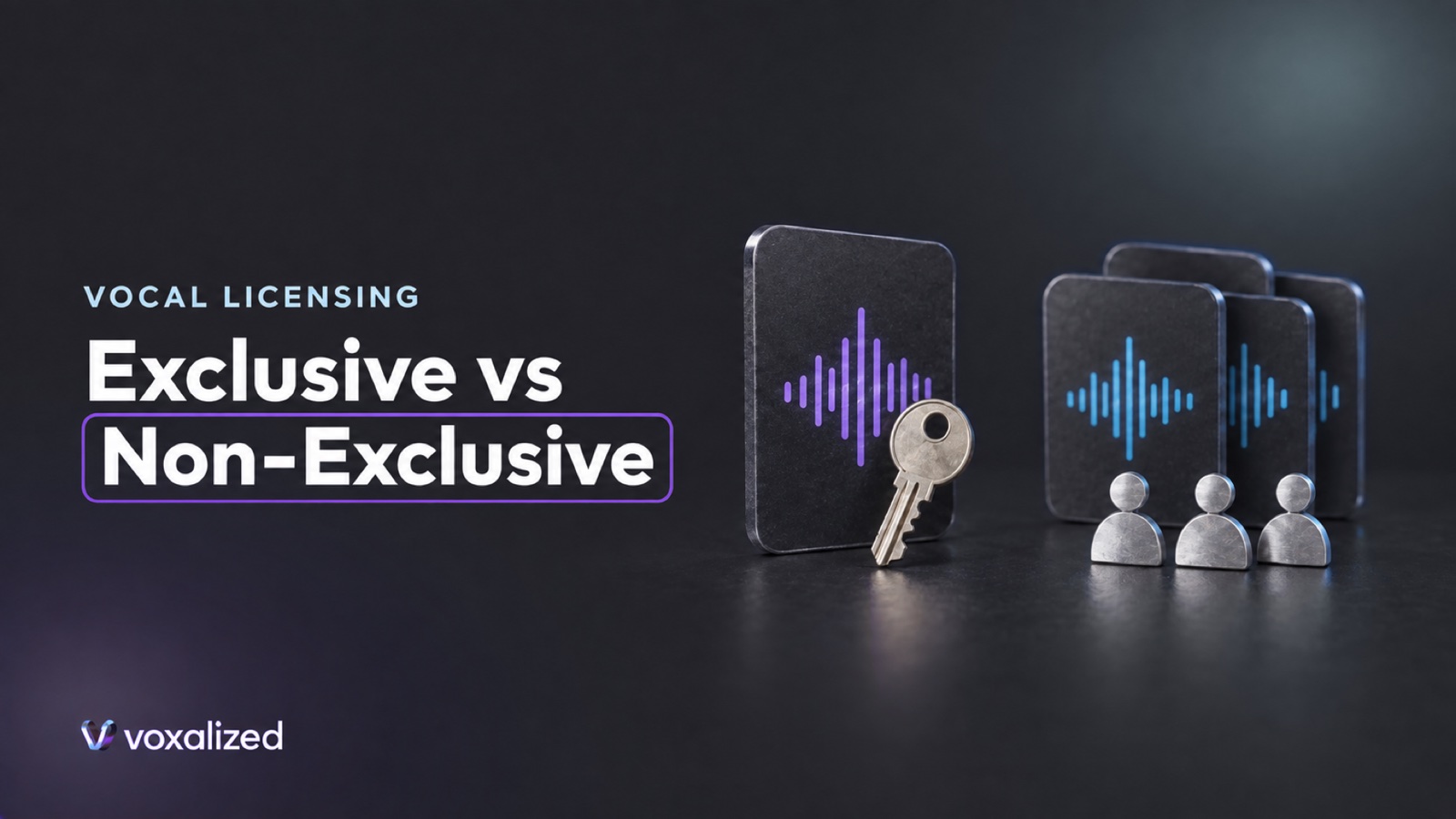
A non-exclusive vocal can be licensed by many producers, costs a one-time fee, and lets you release and keep your master royalties. An exclusive vocal is licensed to you alone and taken off sale, but costs several times more and often comes with royalty splits. For most producers releasing on streaming, non-exclusive is the better deal; exclusive makes sense when uniqueness itself is the point. Here is how the two compare, with prices, the Content ID catch and the stream math, plus how the Voxalized license tiers fit in.
What each license gives you
| Non-exclusive | Exclusive | |
|---|---|---|
| Who can use the vocal | You and other buyers | Only you, from the date of purchase |
| Ownership | A license to use the recording | Usually still a license, with sole usage rights |
| Earlier buyers | Not affected | Their licenses usually stay valid |
| Price | One-time, low | One-time, several times higher |
| Master royalties | Usually 100 percent yours | Yours, unless the deal includes a split |
| Songwriter share | Stays with the writers | Stays with the writers, unless the deal says otherwise |
| Content ID | Not allowed | Sometimes allowed |
| Best for | Streaming releases, fast output, testing ideas | Artist singles, label pitches, sync |
Two points in this table surprise most producers.
First, exclusive rarely means ownership. The Vocal Market puts it plainly: an exclusive license gives exclusive usage rights, and a full copyright transfer is "a separate arrangement and is rare." You own the new track you make, not the isolated vocal.
Second, exclusive does not always mean first. When a vocal that was sold non-exclusively later goes exclusive, the earlier licenses usually stay valid. The vocal disappears from the store, but it may already be on other releases. Ask before you buy.
If you want the case for non-exclusive in more depth, read why non-exclusive vocals are worth considering.
What they cost
Published prices on the marketplaces' own pages, as of September 27, 2026:
| Marketplace | Non-exclusive | Exclusive |
|---|---|---|
| Voqlr | $9.95 to $99 | $199 to $999 |
| The Vocal Market | $10 to $30 in its guide, €20 to €59.99 in the store | $99 to $699 in its guide, €229 to €1,200+ in the store |
| Vocalfy | $34 on the homepage | From $399 |
| Voxalized | Typically €29.99 Standard, €49.99 Professional | Only where a singer offers it |
Custom work costs more. Session singers on SoundBetter and Fiverr set their own rates, from under $100 for a simple gig to several hundred for a written topline. From my own experience working directly with singers, some start at €500 per vocal and also want a percentage. From their side that is completely understandable. From a producer's side, it changes the math.
Royalties and splits
On a non-exclusive license from a vocal marketplace, you typically keep your master royalties, and the singer keeps their songwriter share through their performing rights organization if they wrote the lyrics and melody. We explain that split in royalty-free vocals explained.
On custom deals it is different. A common starting point in songwriting is a 50/50 split of the composition between producer and topliner, and guides for producers list 33 to 50 percent for a topline writer. On top of the fee, that is a large share of your income on every stream, forever.
The Content ID catch
Content ID is where the license type matters most. YouTube's Content ID eligibility rules exclude content licensed non-exclusively from a third party. Most vocal licenses forbid it for the same reason: if one buyer registers a shared vocal, every other buyer's track gets claimed.
Exclusive does not automatically fix this. Ditto Music's Content ID policy also refuses exclusive licenses where the material was previously sold to others non-exclusively. If YouTube monetization through Content ID is central to your plan, you need a vocal that was exclusive from the start.
The stream math
This is the part that decided it for me. I have worked directly with singers, and the advantage is real: nobody else has the vocal. The disadvantage is the vocal fee plus a share of the percentages. As a hobby that does not matter. As a full-time producer you have to think economically, and giving away half of the percentages on top of a fee does not add up.
My rule of thumb: anything above a vocal fee of about €250 is not affordable from streaming alone. The break-even for a fee like that sits at around 400,000 streams, and most releases never get there.
Here is what that looks like at different fees, using the same rate behind that rule of thumb:
| Vocal fee | Streams to earn the fee back | Plus a 50 percent split |
|---|---|---|
| €50 (non-exclusive) | about 80,000 | not applicable |
| €250 | about 400,000 | about 800,000 |
| €500 (custom, direct) | about 800,000 | about 1.6 million |
| €700 (marketplace exclusive) | about 1.1 million | about 2.2 million |
Public per-stream figures are higher than this, because they are gross numbers before labels, distributors and splits. Distributor statement data compiled by Royalty Exchange puts Spotify at roughly $3 to $5 per 1,000 streams on the master side. What reaches a producer after everyone is paid is a fraction of that, which is why the break-even sits where it does. We break down the platform side in Spotify revenue.
The flip side is what a non-exclusive vocal can do. I bought one for €69 and used it on two releases that together reached about 5 million streams. The full story is in a 5-million-stream house vocal. With a 50 percent split, that single vocal would have cost me many times its license fee.
When exclusive is worth it
I have bought a vocal exclusively and I have had several originals made. Apart from complete uniqueness, I saw little advantage. For my own project it did not pay off economically. That does not mean exclusive is always wrong.
| Your situation | Better choice |
|---|---|
| Producer releasing regularly on streaming | Non-exclusive |
| Testing ideas, making demos, pitching quickly | Non-exclusive |
| Building an artist profile around originals | Exclusive or custom |
| Planning YouTube Content ID monetization | Exclusive from the start |
| Pitching a single to a major label or for sync | Exclusive, or ask the label what it requires |
| DJ who plays the track in every set and wants a signature record | Exclusive can be worth it |
If you choose non-exclusive, your production is what makes the track yours. If you want a sense of where to find full vocals rather than loops, see Splice alternatives for vocals.
How Voxalized handles this
Every vocal currently on Voxalized is sold non-exclusively, and every purchase comes with a personalized license agreement between you and the singer. Standard includes the lead vocal dry and wet. Professional adds the premixed vocal, doubles, harmonies, backings, extra stems, MIDI and lyrics. An Exclusive tier exists for singers who choose to offer one, and the license tiers page shows what each includes.
Frequently asked questions
What is the difference between an exclusive and a non-exclusive vocal?
A non-exclusive vocal can be licensed by many producers. An exclusive vocal is licensed to one buyer and taken off sale. In both cases you usually get a license to use the recording, not ownership of the copyright.
Do I own an exclusive vocal?
Usually not. An exclusive license gives you sole usage rights, but a full copyright transfer is a separate and rare agreement. You own your new track, not the isolated vocal.
What happens to earlier buyers when a vocal goes exclusive?
On most platforms, licenses sold before the exclusive sale stay valid. The vocal simply cannot be sold again. That is why an exclusive vocal may already exist on other releases.
Can I register a non-exclusive vocal with Content ID?
No. YouTube does not allow content licensed non-exclusively from a third party in Content ID, and most vocal licenses forbid it, because it would trigger false claims against other buyers.
How much does an exclusive vocal cost?
Published marketplace prices for exclusive vocals range from about $99 to $999, and some go above €1,000. Hiring a singer for an original often starts around €500 plus a share of the royalties.
About the author
 KilianFounder of Voxalized