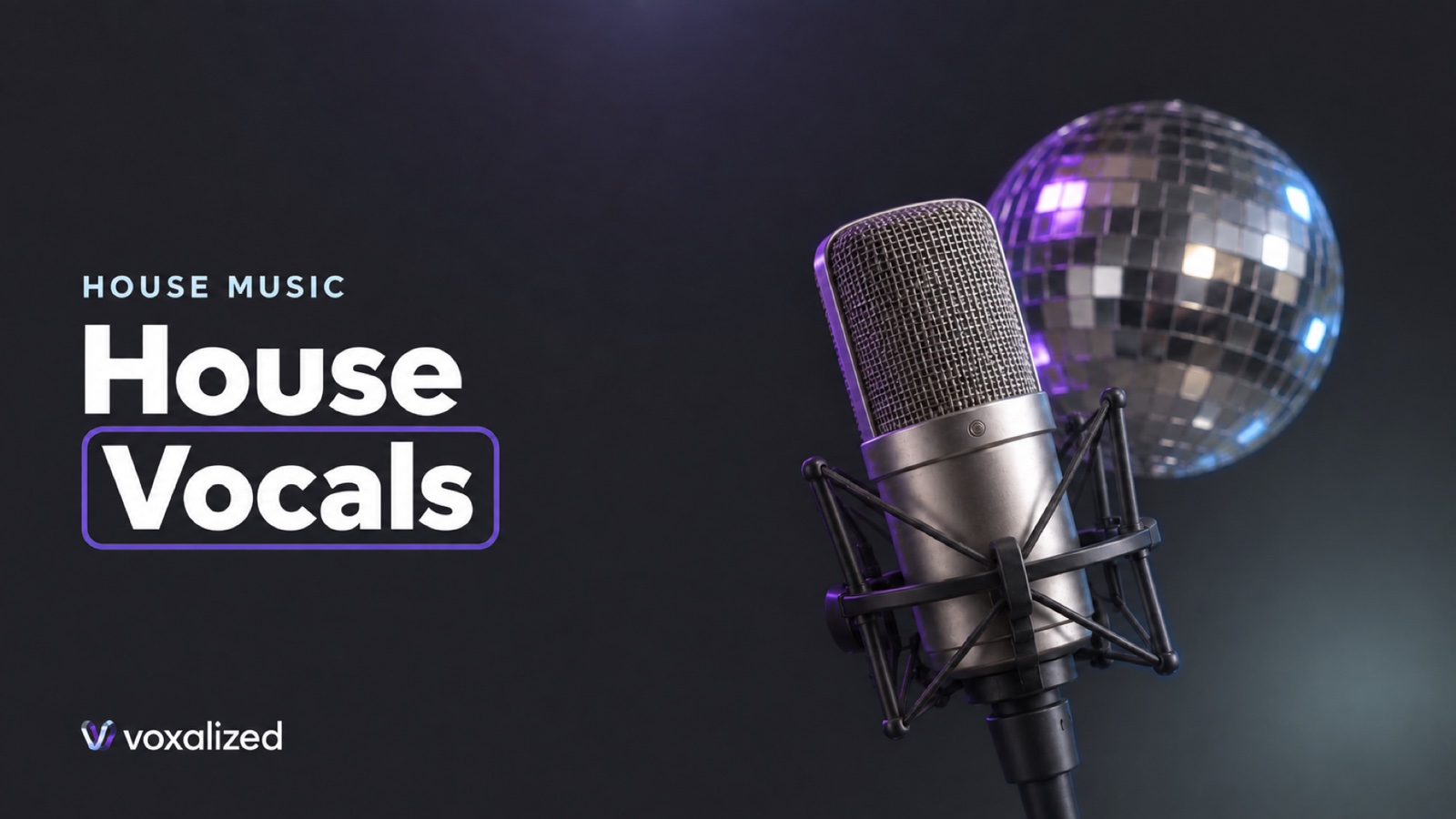
House Vocals: Where to Find Them and How to Make Them Hit (Deep, Tech, Classic)
What makes a house vocal stick, the tempos and keys that dominate the genre, and the story of one non-exclusive vocal that carried two releases to 5 million streams.
Kilian27 September 20268 min read
In this article
A good house vocal is a short, simple melody that people can sing along to after one listen. Tempo, key and sound design matter, but they come second: if the hook does not stick, no drop will save it. This guide covers what makes a house vocal work, the tempos and keys the genre actually uses (with numbers from the deep house vocals on Voxalized), and the story of one vocal that carried two of my releases to around 5 million streams.
What makes a house vocal hit
I produce house under my main project, Kilian K, and techno under Techy Chan. Across both, the lesson is the same: the melody decides. A house vocal has to be short, it has to be simple, and you have to be able to sing along. If it does not stick in your head after the first chorus, it will not stick in anyone else's.
That sounds obvious, but it changes how you shop for vocals. You are not looking for the most impressive singer or the most poetic lyric. You are looking for a phrase that survives being repeated sixteen times over a kick drum. Big runs and dense verses often work against you in house, because the groove needs space and the listener needs something to hold on to.
A quick test before you buy: play the preview once, close the tab, and wait ten minutes. If you can still hum the hook, it is a candidate.
Deep, tech, classic: what each style wants
House is a family, and each branch uses vocals differently.
| Style | Typical BPM | How the vocal is used | What to look for |
|---|---|---|---|
| Deep house | 118 to 124 | Full verse and chorus, often a reworked pop song, warm and intimate | A soft, close lead and a melodic chorus |
| Tech house | 124 to 128 | Short phrases, one-liners, spoken hooks, heavy repetition | A strong rhythmic phrase you can loop and chop |
| Classic and vocal house | 120 to 125 | Big gospel or soul-style lead, call and response | Power, runs and backing vocals |
| Slap house | 120 to 126 | Pop-structured vocal over a bouncy bass | A catchy chorus, clean dry lead for pitching |
These ranges are conventions, not rules. Plenty of deep house runs at 125, and plenty of tech house producers slow a vocal down on purpose.
What the catalogue says about house vocals
We looked at the 69 house-family vocals currently on Voxalized (deep house, house and slap house). They account for most of the catalogue and most of its sales, and the numbers line up with what producers expect.
Tempo
| BPM band | Vocals |
|---|---|
| Under 118 | 17 |
| 118 to 121 | 6 |
| 122 to 123 | 6 |
| 124 to 126 | 26 |
| Over 126 | 14 |
The median is 124 BPM, and 124 on its own is the single most common tempo. The group under 118 is mostly slower deep house and pop-style vocals that producers speed up or build half-time grooves around.
Keys
About 71 percent of the house vocals are in a minor key. The most common keys are A minor and C minor (seven vocals each), followed by E minor, F minor and G minor. Minor keys give you that slightly melancholic, late-night feel deep house is known for, and they sit comfortably under a bassline in the low register.
If you are building a track from scratch, starting in A minor or C minor at 124 BPM puts you where most of the available vocals already are. That makes swapping vocals during the demo stage much easier.
One vocal, 5 million streams
Here is the case I get asked about most. I bought She Doesn't Mind, a vocal by the singer Polar on Voxalized, with a non-exclusive license for €69. It is a 120 BPM vocal in G minor.
I used it on a release under Kilian K, which has reached about 2.1 million streams. Later I used it again on a Techy Chan release, which has reached about 2.9 million streams. That is around 5 million streams from one vocal and one license fee.
The license was non-exclusive, so other producers could buy the same vocal. It did not matter. The two tracks sound nothing alike, and neither sounds like anyone else's version, because the production is what listeners attach to the vocal.
What a revenue split would have cost
Now the thought experiment. Suppose I had worked with a singer on a deal where they receive half of the streaming income. What would that have cost me on 5 million streams?
The answer depends on what a stream actually pays out, which varies by platform, country, label deal and distributor. So here are two assumptions, clearly labeled as assumptions:
| Assumption | Payout per 1,000 streams | Income on 5M streams | Half of that |
|---|---|---|---|
| Industry estimate for Spotify (master side, before label and distributor) | $3 to $5 | $15,000 to $25,000 | $7,500 to $12,500 |
| A conservative producer-side figure | €0.60 | €3,000 | €1,500 |
Even at the conservative end, a 50/50 split would have cost me more than twenty times the license fee. At industry-estimate rates, more than a hundred times. The industry estimate comes from distributor statement data compiled by Royalty Exchange; Spotify itself publishes no per-stream rate.
This is why, as a producer who does not DJ, a non-exclusive license almost always makes economic sense for me. The full comparison is in exclusive vs non-exclusive vocals.
Covers
Around a third of the house vocals on Voxalized are covers: a singer's new recording of an existing song. Deep house and slap house have a long tradition of turning pop songs into club records, and a well-chosen cover gives listeners a melody they already know.
The rule to remember: the vocal license covers the recording, not the composition. The song itself still belongs to its original writers, and you license it through your distributor's cover-song process before release. Our guide on how to legally release a cover song walks through it step by step.
Building the track around the vocal
My workflow for a house track starts with the vocal, not the drums.
- Set the project to the vocal's BPM and import every stem at bar one.
- Load the MIDI, if the package has it, and play through the chords. This tells you the harmony in a minute instead of an hour.
- Mark the sections. The vocal already tells you where the verse and chorus are.
- Build the groove underneath: kick, bass, then percussion. Keep the space around the hook clear.
- Find the one phrase that can carry the drop. Often it is a single line from the chorus, looped or chopped.
For the drop, a chopped phrase often beats the full chorus. Our guide to vocal chops covers how to cut them cleanly from a dry lead. For the lead itself, a house vocal usually wants a tight low end cut, gentle compression and a short plate or room reverb that does not smear the groove. The details are in our guide to mixing vocals.
Where to find house vocals
| Source | What you get | Full vocals | Covers |
|---|---|---|---|
| Voxalized | Full house vocals with stems, MIDI and lyrics, non-exclusive | Yes | Yes |
| Sample libraries (Splice, Loopcloud) | Loops, phrases and one-shots | Rarely | No |
| Other vocal marketplaces | Full vocals, genre mix varies | Yes | Some |
| Hiring a session singer | A custom vocal written for your track | Yes | On request |
Sample libraries are great for textures and one-shots. For a full house song with a verse and a chorus, a vocal marketplace is usually faster. We compare the options in detail in Splice alternatives for vocals.
On Voxalized, the Standard license gives you the lead vocal dry and wet. Professional adds the doubles, harmonies, backings, extra stems, MIDI and lyrics. You can compare the license tiers before you buy. If you are after a female voice in particular, our guide to female vocals covers ranges, keys and mixing.
Before you pick your next house vocal
Listen for the hook first and the singer second. Check the tempo and key against where you want the track to sit, and remember that 124 BPM in a minor key is where most of the options are. Then commit: a simple vocal with a production that is clearly yours will carry further than a complicated one you keep second-guessing.
Frequently asked questions
What BPM are house vocals?
Most house vocals sit between 120 and 126 BPM. In the Voxalized house catalogue the median is 124 BPM, and the 124 to 126 range alone holds more vocals than any other band.
What makes a good house vocal?
The melody. A house vocal has to be short, simple and easy to sing along to, so it sticks after one listen. Clever lyrics and big runs matter far less than a hook people remember.
What key are most house vocals in?
Minor keys dominate. About 71 percent of the house vocals on Voxalized are in a minor key, with A minor and C minor the most common.
Can I use a non-exclusive vocal for a house release?
Yes. A non-exclusive license lets you release commercially and keep your master royalties. Other producers can license the same vocal, so your production has to make it yours.
Are cover vocals useful for house music?
Very. Deep house and slap house lean heavily on reworked pop songs. Around a third of the house vocals on Voxalized are covers, and you release them like any other cover once the composition is licensed through your distributor.
About the author
 KilianFounder of Voxalized