Female Vocals for Your Track: Voice Types, Ranges, and Where to Get Royalty-Free Ones
How to pick a female vocal that fits your track: voice types and ranges, key and tempo matching, mixing tips, and what our catalogue data says about female vocals.
Kilian27 September 20266 min read
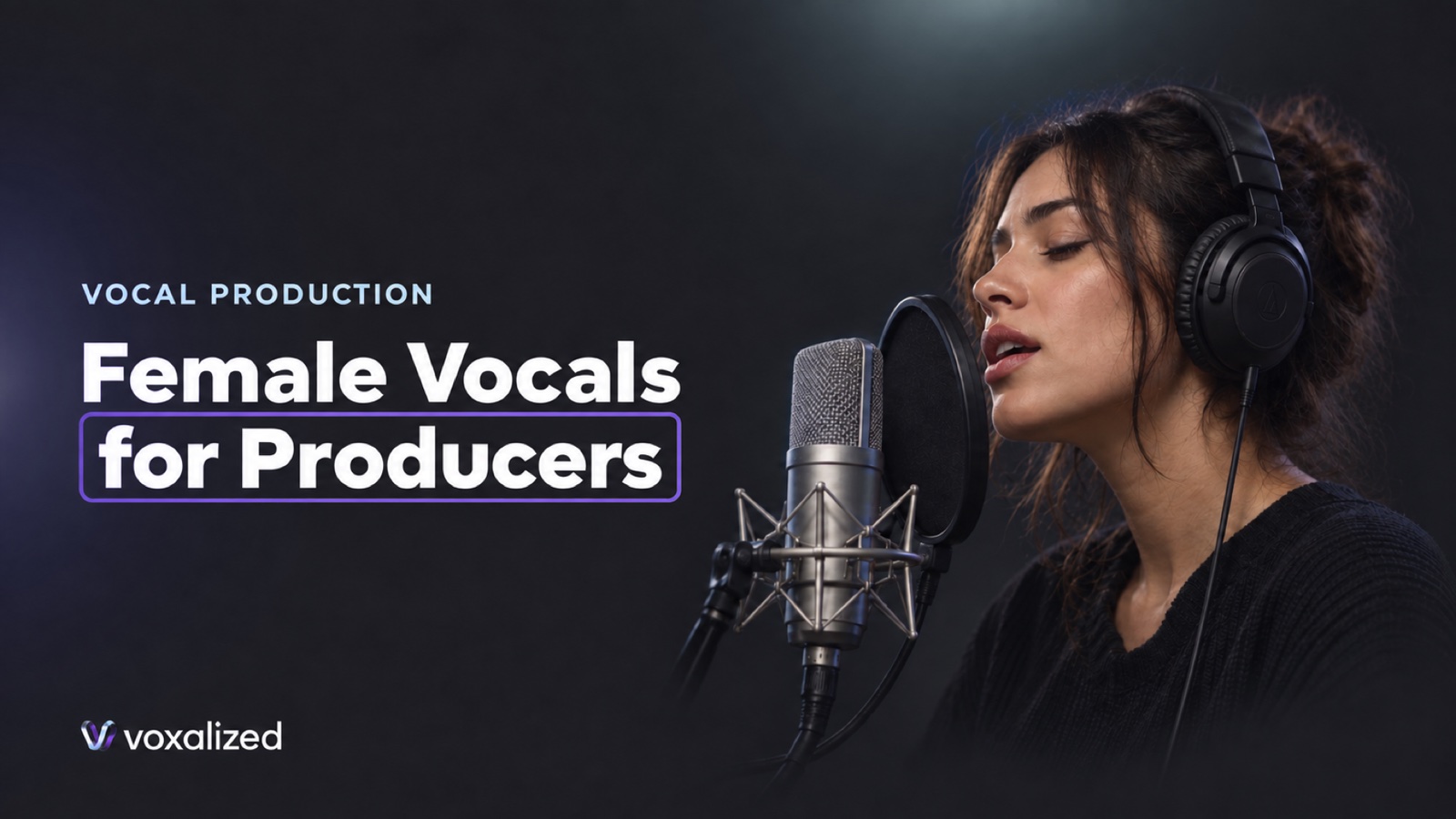
The right female vocal for your track is the one whose range, key and tempo already fit what you are building, so you change as little as possible. That means knowing roughly where a voice sits (soprano, mezzo or alto), matching the key within a semitone or two, and choosing between loops, full vocals and custom sessions. This guide covers all three and adds data from the female vocals on Voxalized about what producers actually buy.
Voice types and ranges
Singers and vocal coaches describe voices by their comfortable range. The boundaries are soft, and a trained singer can go well beyond them, but for a producer they are a useful first filter.
| Voice type | Rough comfortable range | Character | Where it often fits |
|---|---|---|---|
| Soprano | C4 to A5 | Bright, airy, cuts through a dense mix | Trance, big-room toplines, uplifting choruses |
| Mezzo-soprano | A3 to F5 | Warm with a clear top, very flexible | Pop, deep house, most dance-pop |
| Alto (contralto) | F3 to D5 | Dark, smoky, intimate | Deep house, R&B, downtempo, soul |
Most commercial pop and dance vocals sit in the mezzo zone, because it is comfortable for many singers and it leaves room above and below for the production. If your track has a busy top end, with bright synths, hats and a high lead, an alto or low mezzo vocal will often sit more naturally than a soprano competing for the same space.
Matching a vocal to your track
Key
Pick a vocal in your key or close to it. On a dry lead, a shift of one or two semitones usually sounds natural. Beyond that, the formants move with the pitch and the voice starts to sound smaller or thinner than the singer really is. Formant-preserving pitch tools help, but they do not make a five-semitone jump invisible.
If you have not started the track yet, work the other way round: find the vocal first and build in its key.
Tempo
Tempo is more forgiving than key, especially on a dry lead, but consonants and breaths start to smear when you stretch too far. Stay within a few BPM where you can. A vocal at 120 BPM will usually work in a 122 or 124 BPM house track. The same vocal in a 140 BPM track is a different project.
Register against the mix
Solo the vocal against your chords, then against your lead synth. If the voice and the synth fight in the same octave, move the synth, not the singer. A female vocal usually carries most of its intelligibility between roughly 1 and 4 kHz, so leave room there.
What the catalogue says about female vocals
There are 30 female vocals live on Voxalized at the moment. Here is how they compare with the 63 male vocals, based on recorded sales across the catalogue.
| Female vocals | Male vocals | |
|---|---|---|
| Vocals in the catalogue | 30 | 63 |
| Recorded sales | 186 | 317 |
| Sales per vocal | about 6.2 | about 5.0 |
| Share in a minor key | 60 percent | 71 percent |
Female vocals are the smaller group but the stronger seller per vocal. The difference is largest in deep house:
| Female vocals by genre | Vocals | Recorded sales | Sales per vocal |
|---|---|---|---|
| Deep House | 20 | 155 | about 7.8 |
| Pop / R&B | 9 | 15 | about 1.7 |
| Techno / Clubby | 1 | 16 | 16 |
Tempos cluster around the house range: 14 of the 30 sit between 118 and 126 BPM, with a median of 121. Ten more sit between 100 and 117, mostly pop and slower deep house.
Two thirds of the female vocals (20 of 30) are covers. That fits the deep house habit of turning pop songs into club records, and it means you will release many of them through your distributor's cover process. Our cover song release guide explains the steps. If you are working in the house range, our guide to house vocals goes deeper into tempo, keys and hooks.
Mixing female vocals
The general chain is the same as for any vocal, but a few areas need attention more often with female voices.
| Area | Frequency (rough) | What to do |
|---|---|---|
| Low end | Below about 100 Hz | High-pass it. There is rarely anything musical down there. |
| Body | 200 to 400 Hz | Cut gently if the vocal sounds boxy next to pads |
| Presence | 2 to 5 kHz | Where harshness lives. Use a dynamic EQ rather than a static cut |
| Sibilance | 5 to 9 kHz | De-ess here, and do it before any bright reverb |
| Air | Above 10 kHz | A small shelf can add sparkle on a dark mix |
Bright plates and long delays can turn a soprano harsh quickly. Filter the returns so the reverb sits below the vocal's top end. The full chain is in our vocal mixing guide.
Stems and the package
A single acapella file is enough for a demo. For a release, you want the parts: a dry lead to process yourself, a wet lead as a reference, and the doubles and harmonies so you can build the chorus. Our article on vocal stems explained goes through every file type.
On Voxalized, Standard gives you the lead vocal dry and wet. Professional adds the premixed vocal, doubles, harmonies, backings, extra stems, MIDI and lyrics. You can compare the license tiers side by side.
Where to get female vocals
| Source | Best for | Full songs | License |
|---|---|---|---|
| Vocal marketplaces (Voxalized and others) | A finished vocal with verse and chorus | Yes | Written license per vocal |
| Sample libraries | Phrases, chops, one-shots and textures | Rarely | Royalty-free library license |
| Free sites (Looperman, Freesound) | Experiments and sketches | Sometimes | Varies per upload, check each one |
| Session singers (SoundBetter, Fiverr) | A custom topline for one track | Yes | Negotiated per job |
For a full female vocal you can release, a marketplace is usually the fastest and clearest route. We compare the options, prices and licenses in Splice alternatives for vocals.
Choosing your next female vocal
Start with the register your track needs, then filter by key and tempo. Listen for the hook before the voice itself, and check whether the package has the stems you want. If the vocal is a cover, plan the cover release from the start rather than after the track is done.
Frequently asked questions
Where can I get royalty-free female vocals?
From vocal marketplaces that sell full vocals with a written license, such as Voxalized, from sample libraries for loops and one-shots, or by hiring a session singer. For a full song with verse and chorus, a marketplace is usually the fastest route.
What is the difference between soprano, mezzo and alto?
They describe the comfortable range of a voice. Sopranos sit highest, roughly C4 to A5, mezzo-sopranos in the middle, roughly A3 to F5, and altos lowest, roughly F3 to D5. Most pop and dance vocals live in the middle of these ranges.
Can I change the key of a female vocal?
A little. One or two semitones usually sounds natural on a dry lead. Beyond that, formants shift and the voice starts to sound artificial, so it is better to pick a vocal close to your key.
Do female vocals sell better than male vocals?
In our catalogue, female vocals average about 6.2 recorded sales each, against about 5.0 for male vocals. Female deep house vocals do best, at close to 8 sales each.
How do I mix a female vocal?
Cut the low end below roughly 100 Hz, watch the 2 to 5 kHz presence area for harshness, de-ess between about 5 and 9 kHz, and use reverb and delay that leave room for the consonants.
About the author
 KilianFounder of Voxalized